The Power of Out-of-School Time: Education as a Human and Civil Right
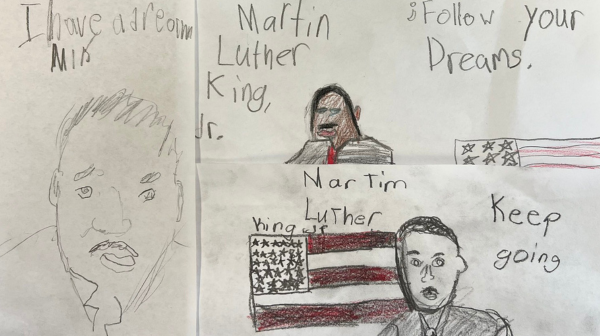
Aspire students created their own bookmarks inspired by Martin Luther King Jr. Day
By Paula Fynboh, CEO
On Martin Luther King Jr. Day, I had the honor of joining my friend and partner, Devanshi Patel, CEO of the Center for Youth & Family Advocacy (CYFA) to host a Listen and Learn in collaboration with Volunteer Arlington & Leadership Arlington’s annual MLK Day of Service.
Grounded in the spirit of service, reflection, and committed action that defines MLK Day, we sat with community members, advocates, and parents to explore a truth that is increasingly urgent, that equitable access to high-quality out-of-school time (OST) programming has the power to liberate the minds and futures of our young people.
Dr. King reminded us that we are “caught in an inescapable network of mutuality.” That belief guided our conversation. Education is holistic, systemic, and highly relational. It is not shaped in isolation, but rather by individual citizens, workplaces, public policy, and most importantly, community. It is all of us, as part of this community, to set the expectation that all of our kids are worthy of our investment and act accordingly to ensure all of our young people’s brilliance and potential is recognized and valued.
During the session, we asked participants to reflect on the value of education and OST from multiple vantage points: as individuals, as parents and caregivers, as employers, and as community members. The answers were deeply personal and strikingly consistent. Education and OST is about dignity. It is about equity. It is about safety, opportunity, belonging, and hope. We were united in our belief that high-quality out of school time programs need to be accessible and affordable so all of our kids have the opportunity to dream big and become all they aspire to be.
We also confronted the consequences of scarcity. Nationally, three in four Black children and nearly four in five Hispanic children who want to participate in OST programs cannot access them, often due to cost, transportation, or lack of availability. The hours between 3:00 and 6:00 p.m., when many parents are still at work, are the hours when young people are most vulnerable without safe, enriching places to learn and grow. At the same time, research shows that every dollar invested in OST returns three to seven dollars to the community through improved academic outcomes, reduced crime, and stronger family stability.
At the Listen and Learn, community members shared short stories that put these statistics into human terms: a teacher who saw the impact of these programs on their students, a college student who mentored younger students in these programs, an employer who understood that investing in families is investing in a stronger workforce. These stories illustrate that when we fail to provide high-quality OST programming to all of our young people, regardless of their family’s ability to afford them, we are limiting the potential of our most vulnerable young people and failing to honor the legacy and dream of Dr. Martin Luther King, Jr.
In the true spirit of MLK Day and putting ideas into committed action, we asked the participants what we can do about this: as individuals, as parents, as employers, and as a community. Participants shared their commitments, such as volunteering in the next few months or calling their representatives to support OST programs, recognizing that systems change begins with individual and collective action, and an acknowledgement that it is ultimately the will of a community to prioritize equitable access to education and OST programs. It is up to us as a community to want for all of our children what we want for our own children.
For me, this conversation renewed my belief in the power of community and reflected a core value that guides my work, that values must be lived, not just talked about. If we believe in equity, access, and opportunity, then we must prioritize these values and put them into action through our budgets, policies, and partnerships. Investing in out-of-school time programming for all children is one tangible and powerful way to do that. It is a living example of the belief that every child’s potential matters and ours is a community that puts that belief into action.
Dr. King taught us that service is not passive and while we celebrate MLK’s Legacy on MLK Day once a year in January, the spirit of service, equity, access, and opportunity is a 365 day a year commitment. In that spirit, we encourage our community to join us at 7pm on March 27th at Kenmore Middle School to keep kids learning. Our community, afterschool providers, youth, parents, advocates, and elected officials will stand up for safe, high-quality afterschool programs for all Arlington kids, and your participation will help us show the broad impact that these programs have for the whole community. RSVP here.