The Potential of Apprenticeships for the Youth Development Field
Aspire recently launched a Youth Development Apprenticeship program, with the goal of redesigning our staffing model after AmeriCorps funding cuts and building career pipelines for young adults who want to enter the youth development field.
Already, this program is making waves.
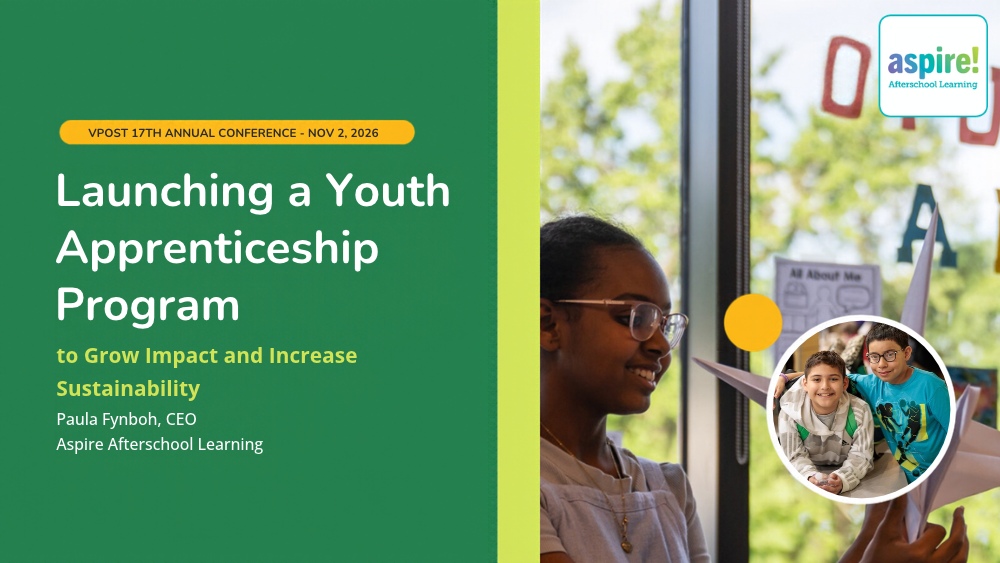
Our CEO, Paula Fynboh, was selected to present at the Virginia Partnership for Out-of-School Time’s (VPOST) recent conference. She helped afterschool leaders from across Virginia explore the process of designing an apprenticeship, how we decided it was right for Aspire, its benefits and challenges, and its potential for the youth development field.
Here are some big takeaways:
Our Model
Aspire’s Youth Development Apprenticeship is an opportunity for young people (age 18-24) from the community Aspire serves to gain real-world professional experience in the field while also making money and earning a credential. Apprentices work at Aspire for one year, helping our instructors and providing personalized support for students, while also learning from a year of courses and mentorship focused on topics like child development and classroom management.
This is exciting for Aspire, because it ensures that our students continue to receive personalized support from trained and passionate instructors. And, it’s a great opportunity for South Arlington, because it creates career development opportunities for our young people.
The apprentice model also has broader implications, as demonstrated by its recognition at the VPOST conference. Across Virginia and across the country, the field is moving toward apprenticeship programs and on-the-job learning. Youth-serving organizations nationwide are facing staff shortages, recruitment challenges, and high turnover. The new U.S. Department of Education priorities emphasize apprenticeships, work-based learning, and industry-recognized credentials. The National Afterschool Association sees credentials as a way to create clearer advancement and strengthen recruitment and retention.
We also know that young adults want these kinds of experiences!
- 48% of recent college graduates said they feel unprepared to even apply for entry-level jobs in their field (Cengage Group’s 2025 Graduate Employability Report)
- 86% of Gen Zs are primarily seeking mentorship and guidance (Deloitte’s 2025 Gen Z and Millennial Survey)
- 88% value on-the-job learning and practical experience for building skills (Deloitte’s 2025 Gen Z and Millennial Survey)
- 55% of Gen Zs said they’ve delayed major life decisions, like furthering their education, because of their finances (Deloitte’s 2026 Gen Z and Millennial Survey)
Apprenticeships meet all of those needs. They provide dedicated learning and training for the youth development field, pair apprentices with a dedicated mentor, and create space for developing skills like professional communication – all while providing a regular paycheck.
Clearly there are many benefits. But there are challenges as well that require consideration before the launch of an apprenticeship program:
- Developing the program and implementing it well requires a significant amount of time and energy from staff, many of whom are already busy and pulled in many directions.
- Finding the funding to pilot the program and sustain it means building new funding connections and fundraising for that on top of existing budget requirements.
- Providing fair wages for apprentices may require scaffolding. Apprentices must make at least minimum wage to start, with a modest raise partway through the year. Aspire is working to raise wages or add an education stipend, in line with our values.
So how can other organizations know if an apprenticeship program is the right fit for them? Aspire ran the decision through our Values Scorecard, asking ourselves if the program would help support students (Growth), reduce the educational opportunity gap in and beyond Aspire (Equity & Access), promote professional development and a highly-qualified team (Excellence), build warmth and playfulness (Fun & Caring), and build bridges for South Arlington students (Connection).
Other organizations should similarly ask themselves whether this program could support their staffing model. Questions include:
- What is the biggest current staffing challenge you’re facing? How could an apprenticeship help?
- Who could become apprentices? Former participants, volunteers, interns?
- Who could help you build a curriculum, recruit, and connect apprentices to jobs?
- Who could mentor the apprentices, and do they have the time, training, and pay to do it well?
- Can you pay at least minimum wage, with a raise during the year?
- How will you fund the program? Who funds workforce development near you?
- Which of your values would this advance? Where might it fall short?
- What would be the challenges of implementing an apprenticeship program?
- Does your team have the capacity to fully think through the details of the program and ensure it’s meeting the needs of your team and your community?
The answer may be that an apprenticeship model isn’t the best fit right now! It is a big undertaking and requires time, energy, and collaboration from your team and partners. But it comes with a huge payoff: benefits for out-of-school time organizations, participants, teams, employers, and the community as a whole.
As Paula shared at the VPOST conference, this apprenticeship model is a perfect example of everything we hope the out-of-school time and youth development fields can be: a way for students to learn and a way for young people to learn, grow, and become future leaders in the field.
If you’re interested in learning more about an apprenticeship model or partnering with Aspire, please reach out! Send us an email at info@aspireafterschool.org and we’re happy to chat.
This article is part two of a series on the new Youth Development Apprenticeship Program. Read the first article here and stay tuned for part three in December!