
When Our Values Show Us What to Do
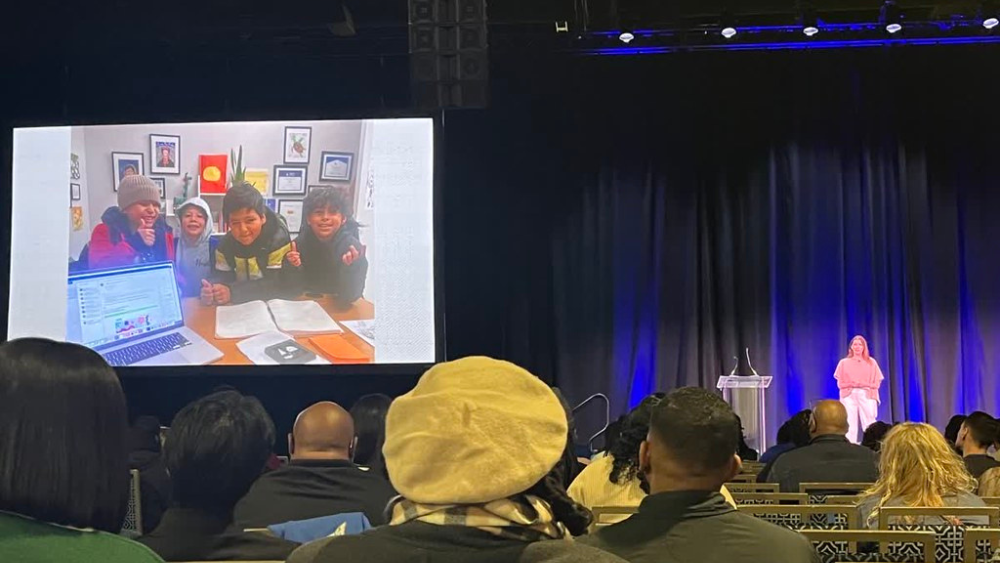
Aspire’s CEO, Paula Fynboh, recently spoke at the National Afterschool Association’s conference about the importance of leading with values. You can find a recording of her talk and her remarks below.
Paula’s Remarks
Almost everything I learned about being a leader, I learned from what was missing.
I saw a lot of leaders willing to put their values on posters… but rarely did I them hold themselves accountable to those values.
Instead, I saw too many leaders compromise their values when things got hard.
And when I asked questions, these same leaders told me I was being too idealistic. That leading with values would inhibit growth and was too rigid, and that I didn’t know what it took to be a leader.
And for a long time, I believed them. I even passed up two promotions because I didn’t think I had what it took to be a good leader. There just wasn’t a roadmap for being the type of leader I wanted to see in the world.
But after becoming increasingly disillusioned by what I experienced as a lack of integrity and moral courage in leadership, I decided I would give it a try. After all, I knew what not to do, and I figured I could just start there.
But before I go any further, I want to pause and define what I mean by the word values, because I think it can often be a loaded word.
I define values as a set of beliefs, that are formed by experiences, and that serve as a type of a North Star or a compass. In short, values are our non-negotiables.
As you listen to my story, I want you to quietly think of your own values… what’s your North Star, what won’t you give away, even when things get hard?
Because for me, as a little girl growing up in a small, rural community, I never saw women in leadership. And because of this, the values of representation, equity, and access guide me. They are my North Star and my non-negotiables.
So when I became the CEO at Aspire, I knew I was gonna make a million mistakes, but I also promised myself I would lead with my values. And because there was no roadmap that I knew of, I decided to create one. I created a “Values in Decision-Making Scorecard.”
And I wanted this tool to serve as a guide in making sure all our decisions aligned with our values, and I wanted to show the kids we work with that leading with your values is possible.
And we use this scorecard for just about everything. Big and Small. Like when our students weighed in our strategic plan. They told us: keep doing what you’re doing, do it for more kids, help us keep our same teachers year and year… and give us more chicken nuggets.
So… we put chicken nuggets through our values scorecard, and it helped us strike a balance between teaching healthy eating and keeping learning fun.
Our values scorecard was a way to make sure everyday decisions, from our curriculum to our hiring, to our budget, aligned with our values.
And then… that scorecard became something else entirely.
Last April… on a Sunday afternoon… I received a 3-sentence email, and that email told me that our federal funding, which represented over one-third of our budget and funded our 17 classroom teachers who mentored our students every day, had just been eliminated, effective immediately.
Now that scorecard mattered more than ever, and I had a choice.
Would I lead in the way that leadership had often been modeled to me? Or would I lead with my values?
Well, that question, it turns out, was the easy one. I knew I would lead with my values. The harder question was how.
And I didn’t know the answer when I woke up at 2 in the morning, picturing the faces of our students, knowing that over one-third these kiddos would now lose access to our program and have no place else safe to go afterschool. And I still didn’t know the answer when I literally thought I would literally throw up the next day as I pulled into the parking lot to tell our classroom teachers that their positions had just been eliminated, effective immediately.
But… I had a roadmap that would help me take the next step forward.
When joining Aspire, I modified RACE Forward’s Equity Impact Tool around Aspire’s values of Growth, Excellence, Joy and Connection… and I included my own values of representation, equity, and access and involved our staff, students, and families in the process.
Our Values in Decision-Making Scorecard became my North Star.
And because our classroom teachers trusted I’d lead with my values, all of them showed up for work the next day while I figured out the next steps, even with their funding and contracts eliminated.
Our community rallied around us, we raised enough money to hire back almost all of our teachers within five days after losing our funding.
And our parents supported us because they knew we’d lead with our values and keep our program at no cost, because the ability to pay should not interfere with the ability to access high-quality, after-school programming or read at grade level or dream big.
Our students saw us and modeled our values back to us, they even organized a lemonade stand to help.
And my staff knew I’d do whatever I could to keep our doors open, while also prioritizing their mental health, because if we truly value our young people, then the people taking care of them also deserve to feel valued.
And even on the hardest days, our classrooms echoed with laughter.
Today, we are back to serving the same number of students we were serving pre-federal funding cuts, while also strengthening our programming.
We have a path forward.
So as it turns out, despite what I was told, leading with values isn’t too idealistic. It doesn’t inhibit growth. It’s 100% possible, It works, and it matters.
And guess what…we don’t need a crisis to lead with our values, we can do it right now.
What’s your North Star? What are your values, and how do they show up in your leadership?
Create your own version of a values scorecard and let it guide you in redefining what leadership can look like, and in what it can feel like and sound like, and in how you prioritize the voices that get heard.
Let’s be the reason our young people don’t pass up promotions.
Instead, let’s be the reason they choose to become leaders.